
Nepal’s political landscape is ever-changing; it is constantly reinventing itself. Nepal has gone through political revolutions, civil wars, and struggles for democracy. Even in this age, Nepalese politics struggles between tradition and transformation. We shall briefly run down the history of the political system of Nepal, stretching from the ancient kingdoms to a modern secular republican state
Ancient Kingdoms (Pre-unification)
Even before Nepal was one unified country, it was home to shepherds and herders. Around 1500 BCE, groups of Indo-Aryan people came from the central asian steppes into the Indian subcontinent. They brought their language, rituals, and customs along, establishing their order in this Himalayan region.
The Kathmandu valley was believed to be a massive lake (Nagadaha or Nagdaha Taal), which, according to folklore, was drained by the sage Manjushree. The fertile land of the valley gave rise to settlements here.
But the hills were also home to a different ethnic group. While the Indo-Aryans brought their cultures (Sanskrit language, traditions, etc), the Kirants were a separate ethnic group likely of Mongoloid origin who migrated from the East (Himalayas, Tibet).
After the Aryans, the Kirants (7th BCE–3rd CE) were the major ruling group of ancient Nepal. The Kiranti rule is the first historically traceable dynasty in Nepal. The first Kirant king, Yalambar, is often mentioned in both folklore and chronicles, with the religion already in place long before the establishment of a strong Hindu presence in Nepal. They had a simple and tribal form of governance.
The Lichhavi period is next (400–750 CE), establishing their rule after the Kirant dynasty. Their rule changed from tribal to a more structured monarchical system. The earliest known Lichhavi king was Manadeva I (464 CE). His inscription at Changu Narayan Temple is the oldest recorded historical document. Under their rule, Hinduism and Buddhism flourished side by side. This era prospered economically through trade and agriculture between India and Tibet. The caste system was also cemented through the Aryan influence.
The Malla era marks the golden age of medieval Nepal. It was the era of art, trade, and political rivalry. Malla in Sanskrit means “wrestler”, and the kings were prideful, coming from the Thakuri lineage.
Unification and the Shahs
But the decline of the Thakuris also splintered Nepal into many small kingdoms that were ruled by local chieftains. The Malla rulers, however, were the most powerful ones thanks to the valley’s fertile lands, trading routes, and culture. The unified Kathmandu valley (12th to 14th century), however, also split into three major city-states:
Kantipur (Kathmandu)
Patan (Lalitpur)
Bhadgaon (Bhaktapur).
Each city had its own King competing with the other in architecture, culture, politics, and wealth. This gave rise to architectural masterpieces still worth marveling at today, like Durbar Square, Taleju, etc.
However, the lack of unity and cooperation among these three states weakened the region a lot. This is why by the 18th century, the entire region was politically weak.
When King Prithivi Narayan Shah of Gorkha launched his unification campaign, the divided Malla kingdoms couldn’t unite against him. In 1769, Kathmandu fell to his forces, marking the end of the Malla rule and the beginning of the Shah dynasty.
He famously described Nepal as a “garden of four castes and thirty-six ethnic groups”, emphasizing unity in diversity. He also implemented policies to protect Nepal’s sovereignty from colonial powers like the British East India Company. Under the Shah’s rule, Nepal’s territory was expanded significantly. It stretched westward into Kumaon and Garhwal and eastward towards Sikkim.
The Anglo-Nepal War (1814-1816) ended with Nepal surrendering large territories, including Sikkim and Garhwal regions, yet it was never colonized.
The Rana Regime
The Shah’s monarchical power was weakening day by day due to the internal court rivalries. In 1846, the infamous Kot Massacre brought Jung Bahadur Rana (then minister) to power. He established a Rana oligarchy that lasted over a century. They ruled the country while keeping the Shahs as purely ceremonial figureheads.
Under the Rana rule, Nepal was isolated from the outside world. The ordinary citizens had little to no rights with the Ranas controlling the administration, military, and justice. Education, justice, and wealth were reserved for the elites only. Jung Bahadur also introduced the Muluki Ain (fundamental law of Nepal), including caste hierarchies.
The Ranas built grand palaces, introduced limited infrastructure (roads, hospitals, the first college), and maintained close ties with British India, even sending Gurkha soldiers to aid the British Empire.
After over a century of tyrannical rule of the Ranas, a new generation of educated Nepalese influenced by the Indian independence movement began to resist the Rana regime. The road to democracy was full of thorns, and many were sacrificed to overthrow the Ranas. The Nepali Congress Party, which was founded in exile, organized the 1950-51 revolution with the support of then King Tribhuvan.
The three-month revolution (November 6, 1950, to February 18, 1951) finally led to the surrender of the Ranas, contributed by the loss of British backing in India. In 1951, King Tribhuvan returned to Kathmandu from India (asylum) and declared the end of the Rana regime, restoring the Shah monarchy.
After the overthrow of the Ranas, a coalition government was formed that had the Ranas, royalists, and democrats. But this system soon proved to be unstable as Nepal had no real experience with democracy. In 1959, B.P. Koirala became the first democratically elected Prime Minister, but it didn’t last long.
This gave an excuse to King Mahendra, heir to Tribhuvan (passed away in 1955), to seize absolute power later in 1960 AD.
The Panchayat System
King Mahendra then introduced the Panchayat System, a partyless political system that banned political parties but allowed some local participation. The true power, however, stayed with the King. There were some infrastructure development projects, the rise of nationalism, and suppression of dissent and censorship under the system. It was the Rana regime again, just under a different head. After Mahendra, King Birendra succeeded him in 1972.
Frustrated by the suppression, in 1990, the People’s Movement (Jana Andolan 1) was led by the Nepali Congress and the United Left Front. King Birendra was forced to accept a constitutional monarchy and multiparty democracy. It also drafted the first constitution that guaranteed fundamental rights and a handful of other laws.
Even after the establishment of democracy in 1990, the country did not see equality and progress. There was rampant corruption everywhere, and the development was very uneven. Poverty, caste discrimination, and landlessness were common in the remote parts of the country.
This discontent gave rise to the Communist Party of Nepal. This Maoist party was led by Pushpa Kamal Dahal (Prachanda) and Dr Baburam Bhattarai. They declared “People’s War” on February 13, 1996, and aimed to end the monarchy. They wanted to establish a socialist republic.
They began with small attacks and raids on police posts and government offices in rural areas like Rolpa and Rukum. Soon, they had control of most of the countryside areas. The government responded with military force, leading to a brutal conflict marked by killings, disappearances, and human rights violations on both sides.
But the ones who suffered the most were the ordinary citizens, caught in the fire between the Maoists and the Government. Farmland stolen, villages pillaged, schools turned into barracks, thousands displaced, and many missing.
Jana Andolan
Although many people objected to the monarchy, King Birendra is remembered as one of the most respected and beloved monarchs in the history of Nepal. He was described as a gentle, thoughtful, and people-oriented king. He was also well educated at prestigious institutions, at Eton College (UK), Harvard University (USA), and Tokyo University (Japan). In 1975, he proposed that Nepal be declared a “Zone of Peace”, a neutral state.
When the Royal Massacre occurred in 2001 (June 1), the entire country was in shock and disbelief. King Birendra, Queen Aishwarya, and most of the royal family were assassinated. Conspiracy theories spread widely, especially when King Gyanendra, who succeeded him, was less popular and more power-driven.
King Gyanendra was seen by the public as authoritarian, secretive, and ambitious. He could never earn the trust of the public like his brother did. So when Gyanendra took the throne, he did his best to increase his royal control.
He dismissed the government in 2002, claiming political instability. Over the years, he continued to weaken the government system. In February of 2005, King Gyanendra took it upon himself to dismiss the parliament and seize absolute power. His excuse was to restore peace and democracy, but to the people, it looked like a royal coup.
This new royal coup triggered mass protests across Nepal, with curfews imposed, people arrested, and activists imprisoned. The Maoist rebels and the democratic parties also joined hands and united against the king, forming the Seven-Party Alliance. This was an unseen event, sparking the 2006 People’s Movement (Jana Andolan II) with millions on the street to end the Monarchy in Nepal.
The longer the protests went on, the more difficult it was to seize power. Even the Royal Nepal Army hesitated to support him. As a result, in April 2006, King Gyanendra reinstated the parliament and gave up his powers. Nepal was then declared a Federal Democratic Republic.
At present, the Shah King lives in Nagarjuna Place with some public appearances. There are still monarchy supporters to this day.
The Post Monarchy Landscape
Post 2008, Nepal underwent a new decade of political turmoil. When the monarchy was abolished after 240 years of Shah rule in 2008, the country was led by the Constituent Assembly. In April of 2008, Nepal held its first Constituent Assembly elections, where Maoists won the most seats and formed a government under Prachanda.
Unfortunately things weren’t as smooth sailing. There was confusion and debate on how the government should be, how marginalized groups should be included, and how Nepal’s provinces should be divided. This Assembly failed and dissolved in 2012.
The elections in 2013 saw the rise of the Nepali Congress and CPN-UML to power.
However, this period would prove to be more chaotic than expected. In April of 2015, a powerful 7.8 magnitude earthquake hit Nepal that killed as many as 9000 people and left millions homeless. Nepal faced a lot of losses and resulted in slowed development. It also became an opportunity for many leaders/figures to embezzle the foreign aid money, as there are still people across the country that are yet to get government aid from the 2015 earthquakes.
After a few months in September 2015, the constitution of Nepal was finally promulgated. But this constitution sparked divisions. A blockade was imposed along Nepal’s Southern border that is believed to be supported by India. It was due to the Madhesi and Tharu communities in the Terai region feel underrepresented in the new government structure. They wanted more representation at the government level and better government control. This blockade caused a huge economic crisis in the entire country, with essential goods like fuel, medicine, and other goods becoming scarce.
These events caused further frustration in the public due to the inaction of the political leaders and the government.
In the following years, Nepal had many changes in its leadership. It would be a new prime minister every year or two, with the coalition constantly shifted among the three major parties:
Nepali Congress (NC)
Communist Party of Nepal–Unified Marxist Leninist (CPN-UML)
Maoist Center
In 2018, KP Sharma Oli (from UML) and Pushpa Kamal Dahal (Maoist Center) announced a historic merger to form the Nepal Communist Party. Since they had a two-thirds-majority in the parliament, they naturally formed the government. People had high hopes for this government, as they believed it would bring political stability, economic reform, and consistent governance.
This unity didn’t last long as there were power-sharing disputes between the two party heads. Oli increasingly had an authoritarian approach, attempting to centralize power and dissolve parliament in 2020. The Supreme Court in 2021 ruled the NCP merger invalid, restoring the two parties as separate entities.
Public frustration grew as leaders seemed more focused on retaining office than solving issues like unemployment, inflation, and corruption.
Sher Bahadur Deuba (leader of Nepali Congress) became the next Prime Minister. During this time, Nepal was battling the COVID-19 pandemic. It led to sluggish economic recovery and rising inflation. It was mostly just negotiating power-sharing deals and cabinet seats.
There was a new general election in late 2022, won by the dominant three traditional parties. However, there was a new party in the government led by TV journalist Rabi Lamichhane. Frustrated by the same old faces in the government, the youth voted for Rastriya Swatantra Party (RSP), becoming the fourth largest party in the Parliament.
Pushpa Kamal Dahal (Prachanda) became Prime Minister again in a surprising twist, which was initially supported by Oli’s UML, before later switching allegiance to the Nepali Congress.
The Gen Z Revolution
These power games, along with ongoing economic strain, youth frustration, and rising disillusionment, laid the groundwork for Gen Z-led protests in 2025.
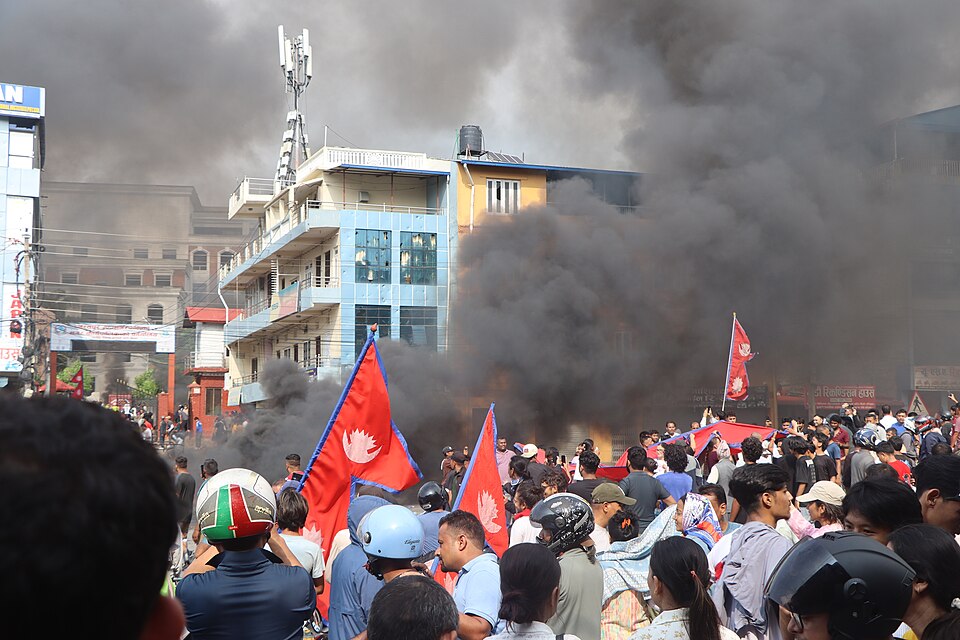
The Gen Z protests in Nepal began as an outcry against corruption, political nepotism, and decades of unfulfilled promises. The final straw was the ban of social media under the guise of not being registered or paying taxes. What started as a callout of Nepo babies flaunting their wealth on social media became an outcry for a change.
Young adults, students, and the youth organized peaceful demonstrations in the capital and many regions of the country, demanding accountability. This nationwide movement turned grim when police started opening fire on the students. At the end of the day, the death toll hit as high as 72, with many injured and hospitalized.
The very next day, security was tightened, though it failed to contain the massive uproar. Politicians’ houses were vandalized, set on fire, and many on the streets, which all ended with the executive body fleeing for their safety. The then-prime minister KP Sharma Oli resigned, and the executive body was dismissed.
Following the massive protest, unwanted arson, vandalism of public properties like the BICC, Supreme Court, Singha Durbar, many police stations, government buildings, the unrest eventually settled down with the appointment of the new interim Prime Minister Sushila Karki.
Moving on from the protests, Gen Z and Nepal as a whole hoped this was a turning point in Nepal’s political awakening. They hoped it wouldn’t be led by the least qualified politicians, but by well-qualified, people-oriented officials for a better future.
There were talks on how the old heads wanted to reinstate the government, calling the interim unconstitutional, and their backers are still many. However, as things stood, Nepal was at the turning point.
Nepal’s politics has always been hectic, from tribal to dynasties to the republican state it is today. Nepal was never colonized by foreign forces, but it wasn’t really free either. Its history is one of resistance and resilience.
image source – wikipedia